
Operational Transformation
Operational optimization and efficiency through machine learning and low-code solutions.
Overview
Ricoh Latam, Ricoh Japan's Latin American division, serves more than 16,000 clients across the region from its base in Miami. The company wants better margins through automation and AI. Ricoh partnered with us to improve service delivery, cut costs, and streamline internal processes.
Areas: Logistics & Operations, Sales, Finance, Supply Chain.
Timeline
- September 2024. Launch of the AI-powered spare parts management project
- December 2024. Launch of the trip and logistics automation project
- January 2025. Development of AI-powered bank reconciliation and data processing tools
- February 2025. Launch of GenAI projects for budgets, backlogs, and predictive models
AI-Powered Forecasting & Inventory
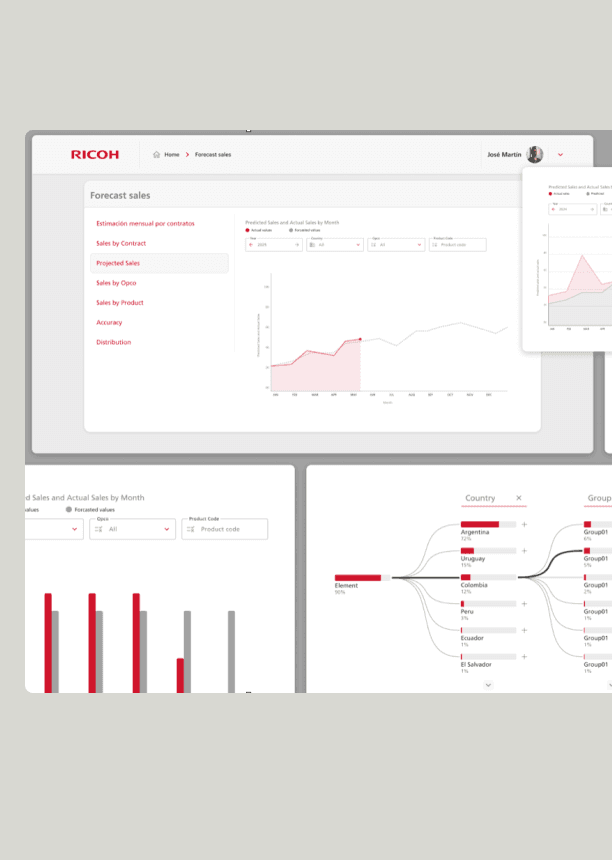
Ricoh's inventory data was split across available stock, in-transit orders, and commercial commitments. That led to stockouts, overstock, and reactive decisions. Sales, planning, and operations struggled to stay aligned.
We built a system that unifies inventory, sales, and planning, consolidating data from AX and D365. It combines historical data, commercial commitments, and operational variables to:
- Predict future demand with greater accuracy.
- Optimize stock levels, avoiding shortages and overaccumulation.
- Provide real-time visibility for sales and planning teams.
Payment Reconciliation Project
Matching payments across banks to their invoices still took heavy manual work, even with rules in place. The goal was to automate matching and leave a path open for AI that finds new rules and raises match rates.
We automated payment-to-invoice matching with rules. AI is not in place yet. The setup is ready for it later. What took 30 to 40 minutes now takes 1 minute.
Travel Logistics Intelligence
Creating travel records (shipments from ports to logistics centers) meant reviewing, consolidating, and manually loading invoices, forms, and other documents. Each entry took more than 90 minutes and errors were common.
We automated the process with AI that detects and extracts data from PDFs and other documents. Processing time fell from 90 minutes to 5. Errors dropped, and the team reclaimed time for higher-value work.
AI-Powered Spare Parts Management
Spare parts consumption data came from multiple sources and was hard to unify. Tracking usage and projecting future needs was slow. The team needed one centralized process.
We centralized and integrated every data source into one system. Data quality improved and access to consumption history got faster. With a single view, the team anticipates demand and decides with more accuracy.
+85%
Accuracy in demand forecasting
-60%
Operational backlog
-40%
in days of stock
Have a similar challenge?
Tell us where you are today. We will map the right entry point and the outcomes that matter.